Overview
Demolition and site clearing in Edmond and Oklahoma City: hazardous material surveys, utility disconnects, permits, debris hauling and redevelopment prep.
Project Details
Category
Area
- Edmond and the Oklahoma City metro
Next step
General Contracting Services
Demolition and Site Clearing in Edmond and the OKC Metro
Taking a building down safely is slower than putting one up, and it should be. Every wall that comes down was holding something, every pipe in it may still carry something, and every cubic yard of debris has to go to a place that is permitted to take it. Demolition is not wrecking; it is construction in reverse, with its own plan, its own permits and its own hazards.
General Contractors of Edmond handles selective interior demolition, full structure removal, foundation and slab removal, site clearing and the disconnection of utilities for commercial, institutional, industrial and multifamily properties across the Oklahoma City and Edmond metro. We prepare the building before the machines arrive, survey for hazardous materials, cut off services, protect neighbors and take the debris to proper facilities, with an eye toward recycling concrete and metal where we can.
Demolition is often the first phase of something larger, and the owner's schedule depends on it. We design the schedule around approvals and storm season, and we tell owners early what the city will ask, because a demolition permit, a utility disconnect and an asbestos notification each have their own lead time.
The Work Before the Work
The first step is a survey. Older buildings may contain asbestos-containing materials, lead paint, PCBs in light ballasts, mercury in switches and fuel or chemicals in tanks. Samples are taken by a licensed inspector, and if hazardous materials are found, an abatement contractor removes them before demolition proceeds. We coordinate the notification the regulators require so the clock starts as early as possible.
Next come the utilities. Electric, gas, water, sewer, telecommunications and fire lines must be disconnected or capped by the provider or by a licensed trade, and we confirm in writing that each is dead before a machine touches the structure. Each provider has its own request process and lead time, so we place those requests first. Only after the building is empty of hazards and services do we set up fencing, dust control, signage and protection for adjacent property.
Selective, Structural and Site
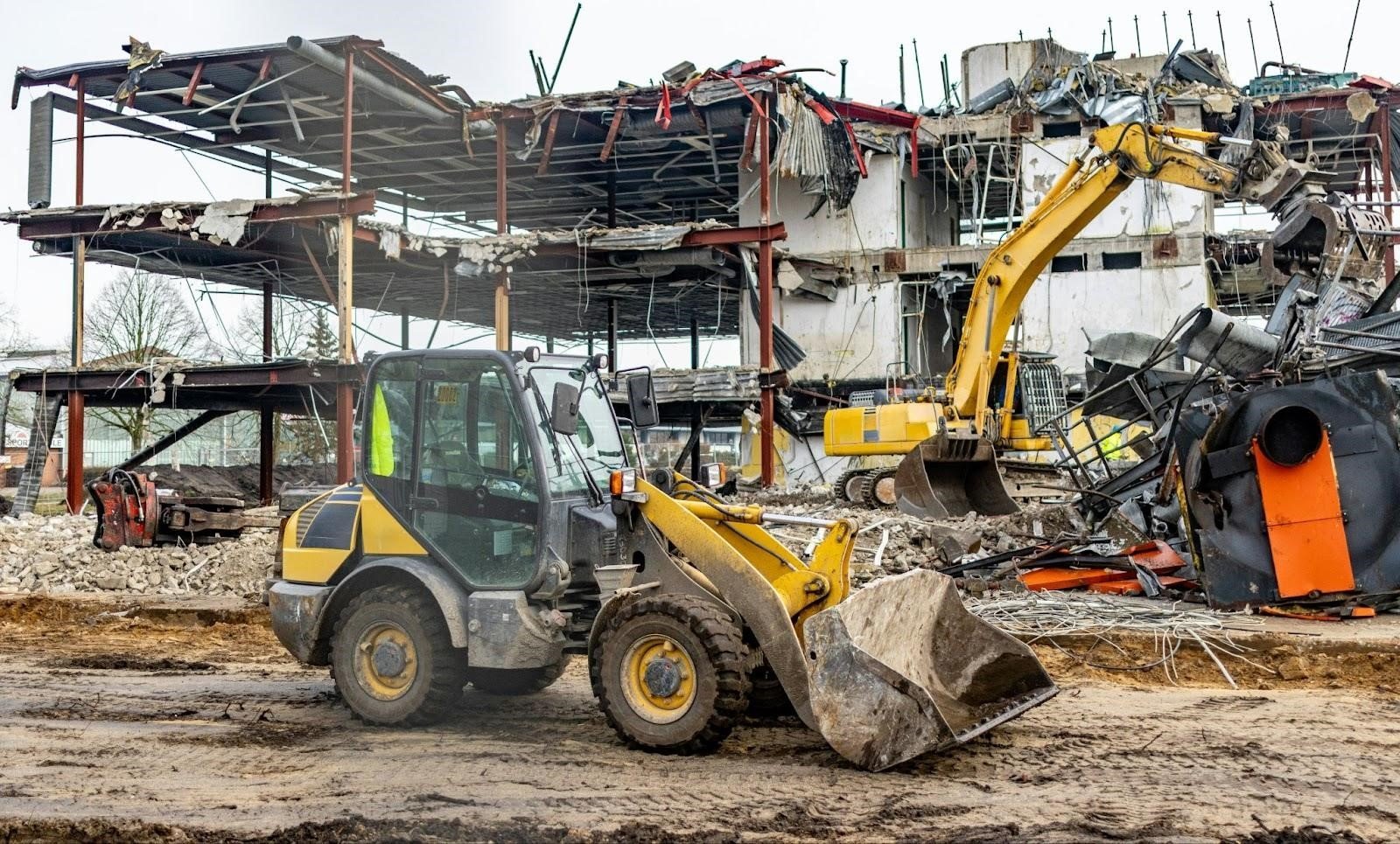
Selective demolition removes parts of a building while leaving the rest in service. It is a precision task, using saws, hand tools and small equipment, and it frequently supports tenant finish and renovation. Structural demolition removes the whole building, usually with excavators using shears, crushers and grapples. Foundation and slab removal follows, and the site is graded and backfilled to the owner's requirements.
Bring-down method depends on the structure. Wood-frame and light steel buildings come apart quickly. Masonry and concrete need more care. Tall or tightly spaced buildings may need to be deconstructed from the top. The trade partners for renovation and adaptive reuse carry out the selective portions, and the same planning applies when a demolition makes way for new grading and foundations.
Permits and Notifications
The City of Edmond states that a building permit is required for adding to or removing the structural framework of a building and for detached structures over 200 square feet. A demolition therefore starts with a permit application, a site plan showing the structure to be removed and, in many cases, proof of utility disconnection. Asbestos regulations require inspection and notification before demolition of many commercial buildings, and the notification period affects the schedule.
Historic and public districts add review. Buildings listed or near listed properties may need approval before they come down, and public property or right-of-way may need a separate permit for barricades and street closures. We prepare the application package and track it, and our permitting and entitlements page explains the broader review picture.
Debris, Trucks and Weather
Hauling is the heartbeat of a demolition. Trucks leave full and return empty, and the number of loads that can be handled in a day depends on the size of the site, the route and the disposal facility's hours. We choose routes that avoid school zones and crowded arterials, wet down the site to control dust and keep the street swept. Where rail crossings are involved, we watch notices such as the August 2026 BNSF maintenance closures at Main Street and 33rd Street in Edmond so loads do not wait at a closed crossing.
Weather affects demolition less than earthwork but still matters. High wind can stop work on tall walls, wet weather turns clay to mud under haul routes and lightning clears the site. After the structure is down, the owner often wants the site graded and seeded quickly, and we coordinate with the next contractor to make sure the handoff is smooth.
What Drives a Demolition Price
Quantity and type of material, hazardous material abatement, disposal fees, the distance to the facility and the proximity of neighbors are the main cost drivers. Salvage can offset cost: structural steel, copper wire, brick and clean concrete may have value or be reusable on site, and we credit the owner where it is practical.
Basements, underground tanks and old foundations are the usual hidden costs. The 60 acres of the Oklahoma National Stockyards, within a 102-acre property that a November 2024 report said was for sale, show how a long-used industrial site can carry history underground. Del City's Increment District 3 financed the remediation of the former Eagle Point Apartments and combined city-owned parcels with sites on Interstate 40 for retail and commercial development, showing the role that clearing plays before redevelopment. Developers can read more at our page for commercial real estate developers.
Clearing Land for Redevelopment
We demolish in the heart of the metro and in surrounding cities. In Del City, clearing sites for redevelopment is often tied to public financing. In Oklahoma City, the Core to Shore tax increment district, established July 1, 2018 with $167,000,000 authorized, is part of a $395,000,000 project area of about 1.3 square miles between downtown and the Oklahoma River, and clearing activity is part of any such plan. Our page for Oklahoma City covers more of the downtown picture.
After severe weather, owners sometimes need damaged structures removed quickly. The National Weather Service rated the May 20, 2013 Newcastle-Moore tornado EF-5, with a path of about 14 miles. We are respectful of the people affected and careful with the process, including insurance documentation, hazard checks and debris separation, and we work with owners and adjusters rather than around them.
Tell Us What Is Coming Down
Send the address, the building description and the planned reuse of the site and we will outline the survey, permits, schedule and price for taking it down safely.
Common Questions
How long does a demolition permit take?
It depends on the city and on whether utility disconnects and hazardous material notifications are complete. Some are issued quickly, while others wait on a required notification period. We submit the full package at once to avoid delays.
Who is responsible for asbestos?
The owner is responsible for having the survey done, and a licensed abatement contractor removes the material before demolition. We coordinate the schedule and make sure the notification is filed, but we do not skip the survey for any building where it applies.
Can the debris be recycled?
Often. Concrete can be crushed and reused as base material, metal is sold for scrap and clean wood or brick may be diverted. Recycling depends on the facility and on contamination, and we report the tonnage when owners want that record.
What happens to the basement and foundation?
They can be removed, filled in place or reused, depending on the planned use of the site. Filling a basement requires clean material placed in compacted lifts and inspected. We confirm the plan with the owner's engineer before backfilling.
How do you protect neighbors during demolition?
With dust control, fencing, monitoring of vibration where needed and advance notice. We keep a point of contact for neighbors, limit noisy hours and repair any damage promptly. Good communication prevents most complaints.
Related
Related Services
Related Service Areas
Ready to talk about your project?
More General Contracting Services
Commercial Construction
Commercial construction in Edmond and the Oklahoma City metro, with permit.
Office Building Construction
Office building construction in Edmond and Oklahoma City: hail-ready envelopes.
Retail and Shopping Center Construction
Retail shopping center construction across Edmond and the Oklahoma City metro.