Overview
Manufacturing facility construction in Edmond and the Oklahoma City metro: equipment-driven layouts, floor loads, utilities and phasing around live production.
Project Details
Category
Area
- Edmond and the Oklahoma City metro
Next step
General Contracting Services
Manufacturing Facility Construction in Edmond and Oklahoma City
Process equipment arrives on its own calendar, and a manufacturing building has to be ready for it on the day the trucks show up. A press line, a paint booth or a test cell can be ordered a year ahead, with a fixed delivery slot and a rigger booked to set it. If the slab, the power and the roof are not done, the owner pays for the delay twice: once to the equipment vendor and again in lost production.
General Contractors of Edmond builds manufacturing space in the Oklahoma City and Edmond metro, from new plants to additions that tie into running production. We plan the work backward from the equipment set date, and we tell owners early what the city will ask, because an industrial permit can stall on utilities and fire protection just as easily as on structure.
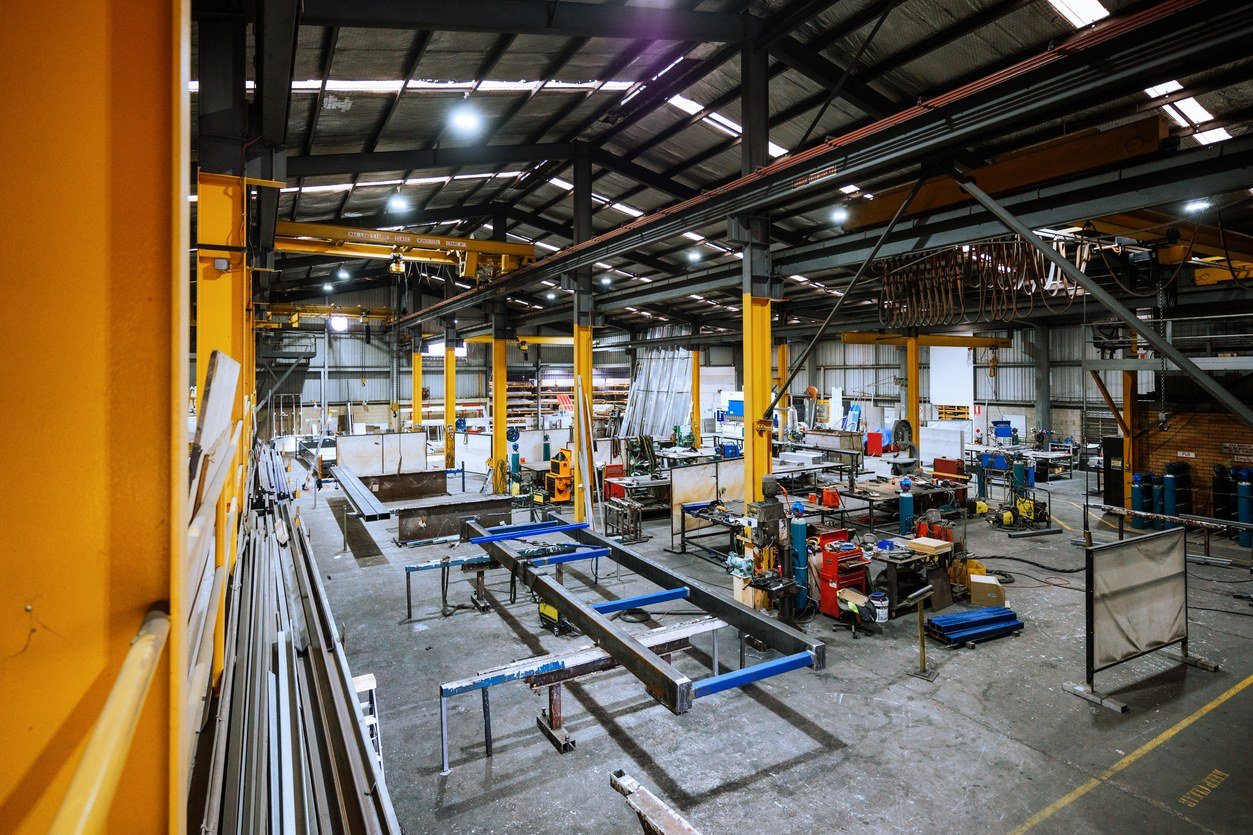
We approach a plant as a system rather than a shell. Floor loads, crane runways, compressed air, process exhaust, wash-down areas and electrical service all shape the building, and they all need answers before the structural drawings are finished.
Building Around the Equipment, Not the Other Way
Start with the equipment list and the flow of material through the building. Receiving, work in progress, assembly, test and shipping should read as a line on the plan, and every crossing of that line is a cost. We ask for the vendor foundation data and the utility demands early, because a machine that needs a heavy isolated pad or a trench for process piping changes the slab, the schedule and sometimes the structural grid.
From there we choose the structure. A heavy fabrication shop with overhead cranes calls for a different frame than an assembly hall with light loads, and our crane building work covers the runway beams, columns and foundations that carry that equipment. For lighter, faster buildings the pre-engineered metal building is often the better value, and we price both so the owner can decide.
What the Metro Has Already Shown Can Be Built
The metro already holds large, serious production space, which tells an owner something about the supply chain. Johnson Controls celebrated the opening of a Rooftop Center of Excellence in Norman, a 900,000-square-foot facility that added almost 400,000 square feet of laboratory and manufacturing space and 150,000 square feet of renovated office space for designing, making and testing HVAC rooftop units. Pratt and Whitney opened a $255 million, 845,000-square-foot military engines facility beside Tinker Air Force Base, with more than 500 full-time employees.
In El Reno, News 9 reported that Flogistix, a maker of components for oil and gas companies, opened a new manufacturing plant that would add about 150 jobs. These are projects by other teams, and we cite them for what they show: the region has the labor, the power and the contractors to support industrial users, and a new plant here is not an experiment. Owners considering Norman, the Tinker area or El Reno will find different land, labor and highway trade-offs in each.
Working Safely Beside a Running Line
Industrial safety on a construction site starts with separating people from equipment, and it gets harder when we are building next to a running plant. We set fencing and travel routes for the owner's forklifts and trucks, schedule crane picks and hot work outside shift changes, and agree who controls each utility shutdown. Lockout and tagout apply to our work as much as to the owner's.
Oklahoma does not currently require a state license for general contracting, according to the Construction Industries Board, but it does require trade licenses and registrations for electrical, mechanical and plumbing work, and local jurisdictions may have their own rules. We verify that every trade on a plant job holds the license the work requires, since a plant's process systems tend to be inspected harder than an office.
Long-Lead Items and the Equipment Set Date
The schedule of a plant is controlled by long-lead items: structural steel, switchgear, transformers, roof-top units, special doors and process equipment. We order what we can as soon as the design allows and track delivery dates against the set sequence. When a critical item runs late, we resequence interior work so the building stays productive, and we tell the owner the effect on the equipment set date at once.
Utilities are the other long pole. Industrial power service, gas capacity and sewer connections are rarely quick, and we begin those conversations during site development and utilities planning, not after the building is under roof. Where the plant must stay in production while we build, we phase demolition and tie-ins into planned shutdown weekends.
Services That Sit Next to the Plant
Manufacturing owners often come to us with a second question: what else can our building do? Warehouse space attached to the plant, a flexible bay that could be leased, and a cross-dock for outbound product all show up on programs. Our flex and light industrial and warehouse teams can design the production and storage areas together.
For owners who need one team to carry the project from concept to commissioning, manufacturing plant projects also fit our design-build and construction management delivery, and the manufacturing industry page describes how we work with those owners.
Start With the Equipment List
Send the machine list, the target start date and the site, and we will return a layout-aware estimate and a schedule that works back from the equipment delivery.
Common Questions
When should we hire a contractor for a new plant?
Before the building design is final, ideally when the equipment list is still moving. A builder can price floor loads, utility runs and crane options and tell you where a small layout change saves a lot of money. We often start with a feasibility estimate, then settle the delivery method once the scope is clear. That sequence keeps the early decisions cheap and the late ones informed.
Can you build while our production keeps running?
Yes, with planning. We separate the work area physically, route construction vehicles and lifting equipment away from your traffic, and tie into live systems during agreed shutdowns. The cost is longer duration and more coordination, and we put that in the estimate instead of surprising you later.
Which building codes will apply to the plant?
The edition depends on the city and the permit date. Edmond lists the 2018 International Codes for permits applied for or issued on or after August 14, 2023, Oklahoma City lists the 2018 International Building Code, and the state adopted 2024 editions effective September 14, 2026. We confirm the edition with the local building department and design to it.
How do you handle hot work and heavy equipment on tight sites?
We write the pick plan, the hot-work permits and the traffic plan before the work starts, and we hold a brief daily meeting with the owner's operations lead. Anything that could affect production, such as a crane swing over a live loading area, is scheduled for a quiet window.
What drives the price of an industrial floor?
Thickness, reinforcement, flatness requirements and curing method are the main factors, along with equipment pads and trenches. A floor for light assembly is a different product from one that carries heavy presses or forklift traffic all day, and we price each condition separately.
Related
Related Services
Related Building Types
Related Service Areas
Ready to talk about your project?
More General Contracting Services
Commercial Construction
Commercial construction in Edmond and the Oklahoma City metro, with permit.
Office Building Construction
Office building construction in Edmond and Oklahoma City: hail-ready envelopes.
Retail and Shopping Center Construction
Retail shopping center construction across Edmond and the Oklahoma City metro.